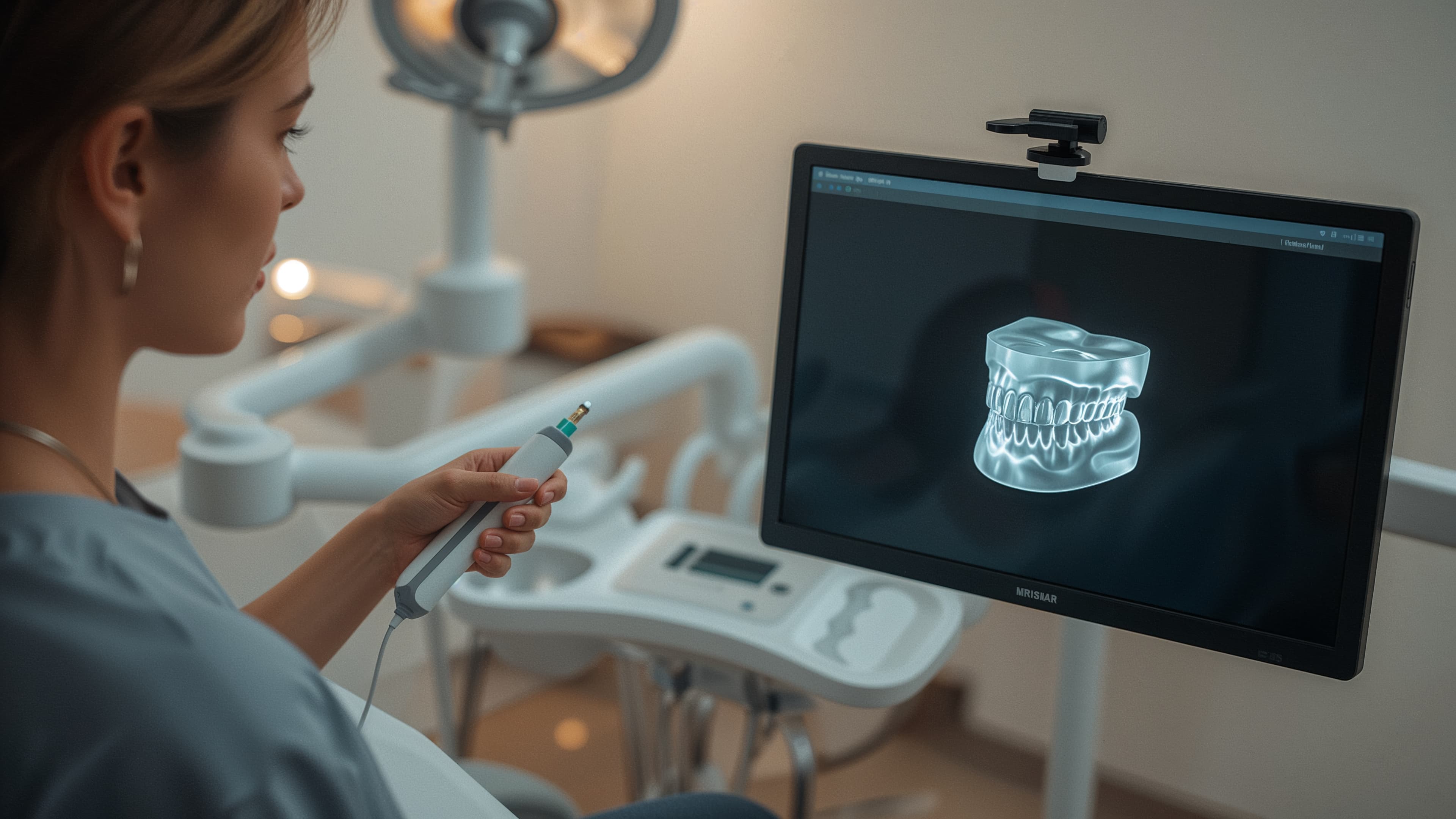
Walk into almost any high-volume Invisalign practice in 2026 and you'll find an iTero scanner on the cart. That's not an accident. iTero pricing reflects a deliberate strategy: Align Technology positions its scanners at the premium end of the market and asks practices to think about the device less as a one-time purchase and more as the front door to an entire digital ecosystem. Understanding how that pricing is structured — hardware, subscription, and the costs you factor in around both — is the difference between a scanner that pays for itself and one that sits underused.
This guide breaks down what iTero actually costs a practice in relative terms, what each plan includes, and how the numbers stack up against alternatives. For the full vendor breakdown, see our iTero review; for the wider category, our guide to the best intraoral scanners covers every major player.
Pricing Overview
iTero, made by Align Technology (the company behind Invisalign, headquartered in San Jose, California), sits firmly at the premium end of the intraoral scanner market. Across its current lineup — the established Element 5D Plus and the newer Lumina built on Align's Multi-Direct Capture optics — hardware lands at a meaningfully higher price point than budget and mid-tier scanners. When independent reviewers describe the market, iTero is consistently the name at the top of the price range.
It helps to think of iTero's cost in two layers. The first is the scanner itself, a substantial capital purchase that varies by model and configuration (cart-based units versus mobile tablet stands, and standard versus the NIRI-equipped Pro version of Lumina). The second is an ongoing monthly software subscription — Align calls it the Comprehensive Service Plan — that bundles warranty, cloud storage, support, training, and design software. Unlike some competitors, iTero does not currently offer a wireless wand, so every configuration is a corded system.
That two-layer structure is the single most important thing to understand about iTero pricing. The sticker price is only the beginning of the conversation, and the subscription is woven deeply enough into the workflow that most practices treat it as part of the cost of ownership rather than an optional add-on.
What's Included in Each Plan
iTero's value is bundled, and the bundle is generous if you use all of it. Here's how the pieces fit together.
The hardware captures 3D models, true-color intraoral images, and — on the Element 5D Plus and the Lumina Pro — NIRI (near-infrared imaging) for radiation-free interproximal caries detection, all in a single scan. NIRI is the standout: no competing scanner currently matches it, and it lets you screen for caries opportunistically at every recall without adding chair time. Note that on the Lumina line, NIRI is reserved for the Pro tier; the standard Lumina focuses on scan quality and speed without the caries-detection layer.
The Comprehensive Service Plan is where the recurring value lives. It typically includes:
- Replacement warranty with accidental-damage coverage
- Unlimited cloud storage and lab integrations through the MyiTero portal
- Customer support and onboarding training
- The iTero Design Suite, with cloud-based exocad for in-house restorative design
- Continuous software updates
The plan is a la carte in name but close to essential in practice. Without an active subscription, the scanner still works and still sends cases to Invisalign, but you forgo software upgrades and pay a per-export fee on lab cases. For any practice sending a steady stream of restorative work to outside labs, the subscription quickly becomes the more economical path — which is precisely how Align designed it. This is deep ecosystem integration, and it rewards practices that lean into the full Align workflow.
Costs Beyond the Sticker Price
The hardware quote is the headline, but a realistic budget needs a few more line items. Align publishes all of these and resellers discuss them openly, but they're easy to overlook on a first pass.
The monthly subscription. Factor in the Comprehensive Service Plan as a recurring operating expense for the life of the scanner. Reviewers place it in the few-hundred-dollars-per-month range. Over a typical five-to-seven-year device lifespan, that's a multi-year commitment that materially shapes your true cost per scan.
Single-use sleeves. iTero uses disposable scanner sleeves for infection control rather than autoclavable tips. They run a few dollars per scan. That's marginal for a low-volume office and a real annual line item for a busy one — a practice doing several thousand scans a year should budget accordingly. The trade-off is simpler sterilization with no tip inventory to manage.
Shipping and processing. Scanner shipments and consumable orders carry shipping and processing fees that scale with order size. Small in the scheme of things, but worth including.
Training time. Align bundles onboarding, but the real cost is staff time to reach fluency. iTero's feature depth rewards training investment — the more your team learns NIRI, the design suite, and the Invisalign workflow, the faster the scanner earns its keep.
Treat all of these as factor-in items from the start. The total cost of ownership is hardware plus subscription plus consumables, and a practice that models all three up front avoids the most common budgeting mistake.