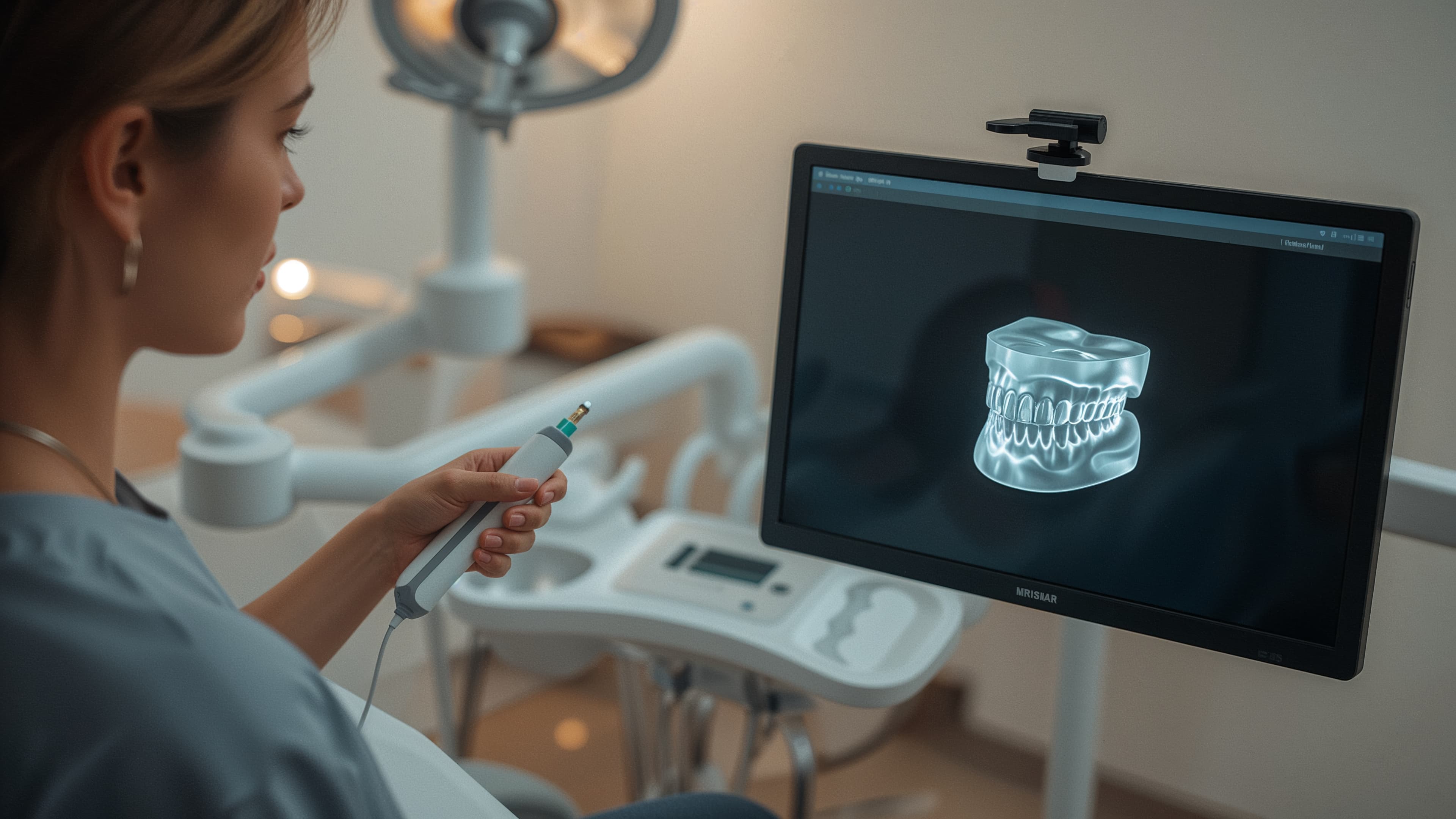
The intraoral scanner you choose in 2026 will shape almost every digital workflow in your practice — restorative impressions, aligner cases, implant planning, lab communication, and patient education. The good news: the leading scanners here are clinically accurate enough for crown and bridge work, and for most restorative cases the differences between them are modest. The harder question is which ecosystem fits your practice, your lab, and the way you actually scan.
We ranked the six intraoral scanners we hear about most from dentists, cross-checked against our independent vendor reviews, third-party lab testing from the Institute of Digital Dentistry, and real practitioner sentiment on Reddit's r/dentistry. No paid placements. No vendor-supplied marketing claims passed through unfiltered.
What to Look For in an Intraoral Scanner
Before the rankings, here's the short list of what actually separates a great scanner from a merely capable one:
- Open vs. closed ecosystem. Can you export raw STL/PLY/OBJ files to any lab, or are you tied to a single restorative pipeline? This decision compounds over years.
- Scanning speed and full-arch handling. Most modern scanners can capture a full arch in under 90 seconds1 — but ergonomics, weight, and tip size determine whether your team can do it comfortably 30 times a day.
- Software depth. AI margin detection, automatic soft-tissue removal, bite analysis, smile design, and aligner simulation are now table stakes on premium scanners. The depth and polish of these features varies widely.
- Restorative accuracy and mesh quality. For crown and bridge dentistry, mesh density and margin clarity matter. For ortho or aligner cases, raw accuracy matters less than workflow integration.
- Total cost of ownership. The sticker price is only the start. Factor in subscription tiers, software modules, tip replacements, training, and lab integration fees.
- Ecosystem fit. If you already run an in-house mill, an Invisalign-heavy practice, or a lab partnership built around a specific software stack, the right scanner is often the one that plugs into what you already have.
The Top Picks
1. Medit i900 / i700 — Best Overall Value
Medit has quietly become the open-ecosystem favorite for general practices that want premium hardware without a premium subscription stack. Medit's scanners are among the lightest on the market — the i700 weighs in at 245 grams2 — and the i900 carries that same light-wand design. Medit's app bundle — Design, Splints, Smile Design, Crown Fit, and more — is provided free to Medit scanner owners,3 covering much of what other vendors charge extra for.
Real-world feedback consistently highlights two things: the ergonomics of the lighter wand reduce fatigue across a full day of scanning, and open file export in STL, PLY, and OBJ4 gives practices freedom to work with any lab or design software. The trade-off is a slightly less polished onboarding experience compared to the iTero or Primescan plug-and-play feel — Medit rewards practices willing to invest a little time learning the software.
Best for: General practices, multi-lab workflows, in-house printing setups, cost-conscious owners who want premium hardware.
Read our full Medit review for feature depth, pricing tiers, and where Medit fits in your stack.
2. 3Shape TRIOS 5 / TRIOS 6 — Best All-Around Workhorse
If you asked a room of digital dentists to name the most versatile intraoral scanner of the last five years, 3Shape's TRIOS line would top the list. TRIOS 5 — and the newer TRIOS 65 — handles restorative, implant, ortho, and full-arch cases across a single platform.
The 3Shape software ecosystem — TRIOS Design Studio, Smile Design, Patient Monitoring, Splint Studio — runs deep,6 and its open architecture connects to third-party labs and design software rather than tying you to a single pipeline.7 Wireless operation on TRIOS 5 makes operatory-to-operatory portability easy.8 Practices invested in the 3Shape workflow tend to treat it as a versatile workhorse that handles a broad, mixed case mix.
Best for: Mixed restorative + ortho practices, edentulous cases, lab-heavy workflows, multi-operatory clinics that need wireless mobility.
Read our full 3Shape review for the complete TRIOS lineup and software ecosystem breakdown.
3. CEREC Primescan 2 — Best for Same-Day Dentistry
Dentsply Sirona's CEREC Primescan has long been regarded as one of the most accurate intraoral scanners, and Primescan 2 keeps that reputation while moving the platform toward a cloud-native architecture.9 For same-day crown workflows paired with a CEREC mill, it has a strong chairside reputation — one in-house-milling dentist on r/dentistry put it plainly, calling CEREC unbeatable for same-day work.10
The trade-off is a larger wand, which can make distal molars trickier, and the platform is at its strongest inside the Dentsply Sirona ecosystem. Open STL export works,11 but the magic happens when you're using DS labs and DS chairside milling together.
Best for: Same-day chairside dentistry, in-house CEREC milling, restorative-heavy practices that prioritize margin precision.
Read our full CEREC review for chairside workflow details and the Primescan 2 transition.
4. iTero Lumina / Element 5D Plus — Best for Invisalign Practices
If your practice runs heavy Invisalign volume, the iTero scanner family is purpose-built for that workflow. ClinCheck integration and seamless Invisalign connectivity12 turn the scanner into a powerful case-acceptance tool. The Lumina also brings a wider field of view and NIRI (near-infrared imaging) for caries detection without ionizing radiation.13
Practitioner feedback is consistent: for ortho and aligner-driven practices, iTero is the obvious choice. For broader restorative work — especially edentulous cases or complex crown and bridge — the workflow is more limited than TRIOS or Medit, and because iTero is optimized around the Align workflow, open-lab options are narrower than on open systems like TRIOS or Medit.
Best for: Invisalign-heavy practices, ortho-focused clinics, GPs whose case mix leans aligners, multi-location DSOs already standardized on Align workflows.
Read our full iTero review for the Lumina vs. 5D Plus breakdown and Invisalign integration depth.
5. Planmeca Emerald S — Best for CBCT-Integrated Practices
Planmeca's Emerald S sits in a different niche than the four above. It's a capable standalone scanner, but its real strength is the Romexis software platform that ties together CBCT, panoramic imaging, intraoral scans, and CAD/CAM design in one unified ecosystem — completed scans drop straight into Romexis for further use.14 For practices that have invested in Planmeca CBCT and want a single vendor running their digital imaging stack, Emerald S removes a lot of friction.
Romexis is one of the more mature integrated imaging platforms on the market, and Planmeca's complete chairside CAD/CAM system — Romexis CAD/CAM software paired with a Planmeca mill — closes the loop on same-day dentistry.15 The scanner itself is light and color-capable, with an autoclavable tip that some teams prefer over disposable options.16
Best for: Practices already running Planmeca CBCT, integrated imaging workflows, clinics that want one vendor for the entire digital stack.
Read our full Planmeca Romexis review for the integrated imaging picture.
6. Carestream CS 3800 / 3700 — Best for Carestream Imaging Practices
Carestream's CS 3800 wireless scanner17 rounds out our list as a solid choice for practices already invested in the Carestream imaging ecosystem. It's a capable scanner with an open workflow that lets you route cases to the labs and design partners you choose.18 Like Planmeca, the strongest case for Carestream is integration: if your CBCT, pano, and 2D imaging are already running on Carestream, the CS 3800 keeps everything in one platform.
Software depth is more modest than Medit, TRIOS, or Primescan — Carestream is a well-rounded all-rounder rather than a feature leader — but for the right practice, the integrated workflow benefit outweighs the feature gap.
Best for: Practices standardized on Carestream imaging, GPs who want a single-vendor digital stack, owners who value workflow simplicity over feature breadth.
Read our full Carestream Dental Imaging review for the full imaging ecosystem picture.
Quick Comparison
| Scanner | Best For | Ecosystem | Software Depth | Relative Price |
|---|---|---|---|---|
| Medit i900 / i700 | Value + open workflows | Open | Deep (free apps) | Mid |
| 3Shape TRIOS 5/6 | All-around versatility | Open + 3Shape ecosystem | Deep | Premium |
| CEREC Primescan 2 | Same-day chairside | DS-centric, exports open | Deep | Premium |
| iTero Lumina | Invisalign-heavy ortho | Align-optimized | Deep (ortho-leaning) | Premium |
| Planmeca Emerald S | Integrated imaging | Romexis ecosystem | Mid | Mid–Premium |
| Carestream CS 3800 | Carestream-stack practices | Open + Carestream | Mid | Mid |
Pricing in the dental scanner market is famously opaque — every vendor negotiates differently based on package, financing, and trade-in. We use relative pricing here because what you actually pay depends heavily on what you bundle. For a more specific picture, our individual vendor reviews break down what dentists report paying.
How We Evaluated
We weighted six factors when ranking these scanners: clinical accuracy and mesh quality, software depth and AI features, ergonomics and scanning speed, ecosystem openness, total cost of ownership, and discussion in the dental community.
Our editorial ratings are informed by our own independent vendor reviews, third-party lab comparisons from the Institute of Digital Dentistry, and discussion on Reddit's r/dentistry. We don't take vendor sponsorships, demo units, or paid placements — every ranking on this page is independent.
A note on accuracy claims: independent in-vitro research supports the idea that leading intraoral scanners are clinically accurate enough for crown and bridge work. One peer-reviewed comparison of scanners on single-crown preparations — including TRIOS, Primescan, iTero, and Planmeca Emerald — found digital impressions clinically acceptable for fixed restorations, with Primescan the most accurate and Emerald showing the most deviation among the group.19 The ranking decision should be driven much more by ecosystem fit, ergonomics, and software workflow than by raw accuracy headlines.
The Bottom Line
The "best" intraoral scanner depends entirely on the workflow you're building. If you want open exports and the best value-to-performance ratio, Medit is the clear pick. If you want a true all-around workhorse with the deepest software ecosystem, TRIOS earns its premium. If same-day chairside is your model, Primescan 2 still sets the standard. And if Invisalign drives your case mix, iTero is purpose-built for that pipeline.
The good news in 2026: there are no bad choices on this list. Every scanner here is clinically capable. The right one for your practice is the one that fits the digital workflow you actually run.
Not sure which scanner fits your practice? Take our dental software match quiz for a personalized recommendation based on your practice size, case mix, and existing tech stack.
Sources
Backed by 12 sources · 8 independent
- Institute of Digital Dentistry — TRIOS 5 review
- Institute of Digital Dentistry — Medit i700 review
- Medit Support — Medit Apps Paid Plans
- Institute of Digital Dentistry — Medit i700 review
- 3Shape — TRIOS & Unite software updates
Show all 19 sourcesShow fewer sources
- Institute of Digital Dentistry — TRIOS 4 review
- Institute of Digital Dentistry — TRIOS 4 review
- Institute of Digital Dentistry — TRIOS 5 review
- Institute of Digital Dentistry — CEREC Primescan 2 review
- Reddit r/Dentistry — in-office milling thread
- Institute of Digital Dentistry — CEREC Primescan & Primemill review
- iTero — Lumina scanner page
- iTero — Lumina scanner page
- Planmeca — Emerald S intraoral scanner page
- Planmeca — Emerald S intraoral scanner page
- Planmeca — Emerald S intraoral scanner page
- Dental Products Report — CS 3800 wireless scanner
- Dental Products Report — CS 3800 wireless scanner
- Diker & Tak, J Adv Prosthodont 2020 — six-scanner single-crown accuracy study
Figures are compiled from the sources listed and may change as those sources update. Spotted an error?