Most lab pricing conversations start with a number. Dandy's starts with a question: how much restorative work does your practice actually send out each month? That single answer drives nearly everything about whether Dandy pencils out for you, because Dandy isn't a scanner you buy or a lab you mail cases to in the traditional sense — it's both, bundled into one relationship. Understanding Dandy pricing means understanding that bundle, not just a fee schedule.
Dandy is the digital dental lab founded in 2020 and headquartered in New York. It fabricates the full restorative range — crowns, bridges, implants, full and partial dentures, night guards, splints, surgical guides, and sleep appliances — out of US facilities in Utah (fixed work) and Texas (removables). What makes its pricing distinct from a conventional lab is the model wrapped around those per-case fees: an intraoral scanner and onboarding provided as part of the partnership rather than a large upfront purchase. This guide walks through how that model is structured, what to factor in beyond the per-case price, and how it compares to the alternatives — including buying your own scanner and choosing your own lab. For our full take on the platform itself, see our Dandy review.
Pricing Overview
Dandy prices on a per-case basis, the same way any lab does — you pay for each crown, denture, or guard you order. Where it diverges from a traditional lab is the monthly lab minimum. Instead of charging you upfront for the scanner, Dandy asks practices to commit to a baseline of lab work each month. As long as your case volume clears that threshold, the scanner, chairside software, and replacement scanner tips come with the relationship at no separate charge.
On a per-unit basis, Dandy's published positioning puts its standard zirconia crowns at or below what many traditional labs charge, with shipping included and a long warranty attached. Dentures and partials are priced per arch with flat pricing — clasps on partials, for example, don't carry an extra charge. Surgical guides are priced per implant site at a level that undercuts a lot of third-party guide providers. The headline isn't any single fee; it's that the per-case rates are designed to be competitive with or below traditional labs while the hardware cost is folded into ongoing lab spend rather than billed separately.
For practices weighing the dollars-and-cents specifics, the live per-case figures and current minimum tiers are best confirmed directly during a Dandy demo — they shift with promotions and the scanner option you choose, and they're exactly the kind of number worth getting in writing.
What's Included
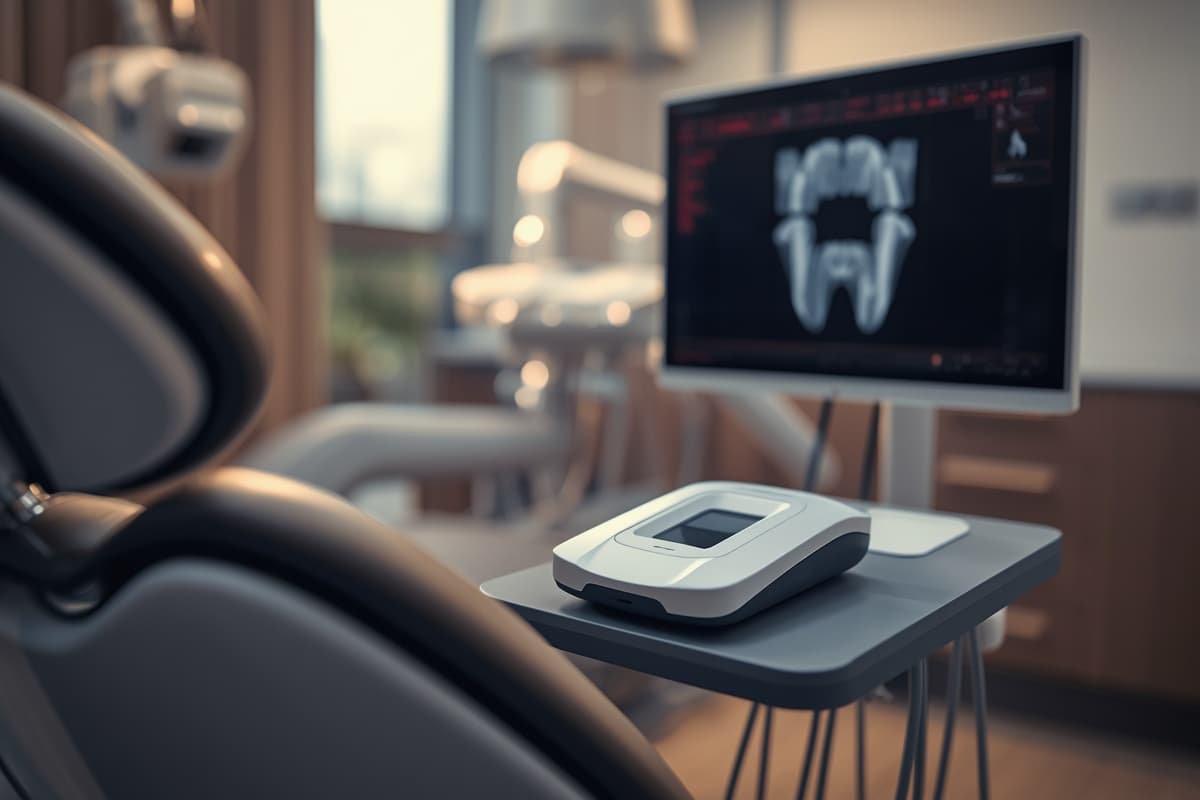
The core of Dandy's offer is that the intraoral scanner arrives at no upfront cost. The company places its Dandy Vision scanner (carrying a list value in the tens of thousands) with practices that sign the standard agreement and meet the monthly lab minimum. Practices that prefer the 3Shape ecosystem can opt for a wireless Trios 5 instead, which sits at a higher monthly minimum tier. Either way, you're avoiding the large capital outlay a standalone scanner purchase would require.
Beyond the hardware itself, the relationship includes:
- The chairside software, with no separate monthly software fee. This covers case submission, AI-assisted scan review that flags prep issues before the patient leaves the chair, and smile-simulation tools.
- Replacement scanner tips, provided within defined annual limits sized for a busy practice's scanning volume.
- Structured onboarding, including installation, staff training on scanning protocols, and live chairside support — dentists can reach a lab technician in about a minute when a scan gets tricky.
- Free remakes and long warranties on eligible cases, with fixed restorations like crowns carrying a notably longer warranty than most conventional labs offer.
One detail worth understanding clearly: Dandy retains legal title to the scanner. It's placed as a loaned asset tied to the agreement, not sold to you. That's the trade for skipping the upfront equipment cost — a structure that rewards practices planning a long-term lab relationship.
Costs Beyond the Sticker Price
The per-case fee is the headline, but a few things are worth factoring in when you model your real monthly cost.
The monthly minimum is a floor, not a cap. If your case volume dips below the committed threshold in a given month — say you're out for vacation or your restorative mix is light — Dandy's policy is that you simply pay the difference (and they'll waive the minimum for a planned absence if you give notice). For a practice doing steady bread-and-butter restorative work, the minimum is usually cleared without thinking about it. For a low-volume or highly specialized practice, it's the single most important number to model honestly against your own production.
Remakes and warranty terms. Dandy's public stance is free remakes on qualifying cases, which is more generous than many labs that distinguish lab-fault from doctor-fault remakes. The exact eligibility — time windows, whether the original restoration needs to be returned — lives in the practice agreement, so it's worth reading those specifics rather than assuming.
Rush and out-of-pattern cases. Dandy emphasizes predictable turnaround (roughly five days on crowns) rather than a published tier of rush surcharges. There's no widely advertised rush fee schedule, which is a plus, but genuinely urgent or unusual requests are the kind of thing to clarify directly so there are no surprises.
Scanner terms on exit. Because the scanner is loaned rather than owned, leaving the relationship means returning the device. That's not a hidden anything — it's the natural consequence of the no-upfront-cost model — but it does mean your hardware and your lab choice are linked. Worth noting if you value the freedom to switch labs case by case.
How Dandy Compares on Price
There are really two comparisons that matter.
Versus a traditional analog lab. On standard crowns, Dandy's per-unit pricing tends to sit at the lower end of the typical analog range, with shipping included and longer warranties. Turnaround is generally faster and more consistent thanks to centralized digital manufacturing, and the flat pricing on partials removes the per-clasp and per-design add-ons that some analog labs apply. The trade is the monthly commitment and consolidating most of your work with one vertically integrated partner. A conventional lab lets you spread cases around and negotiate à la carte; Dandy trades some of that flexibility for lower unit fees and deeper integration.
Versus buying your own scanner and choosing your own lab. This is the comparison most practices wrestle with. Purchasing a scanner outright — an iTero or a Medit, for example — is a substantial upfront capital decision, often financed over several years, and it usually carries its own software or service considerations. The upside is total freedom: you can send crowns to one lab, implants to another, and complex aesthetics to a boutique technician, switching whenever pricing or quality dictates. Dandy's model removes that upfront equipment decision entirely and converts it into ongoing lab spend — effectively a scanner financed through your case volume — at the cost of tying your hardware to one lab. If you want to weigh specific devices, our intraoral scanner buyer's guide breaks down the own-it options side by side.
Neither path is universally better. It comes down to how much you value flexibility against how much you value skipping the capital outlay and simplifying to one relationship.
Is Dandy Worth the Investment?
The honest answer scales with your crown-and-restorative volume.
Higher-volume general and PPO practices are the most natural fit. A practice routinely placing a dozen or more crowns a month, plus the occasional denture, guard, or implant case, will typically clear the monthly minimum on crowns alone — at which point the scanner genuinely functions as a subsidized asset, and the lower per-unit fees compound against fixed PPO reimbursement. For this profile, the minimum stops feeling like a constraint and starts feeling like a baseline you'd exceed anyway. Dandy's reimbursement-aligned denture program, which adjusts pricing on qualifying low-reimbursement cases, sweetens this further for insurance-driven practices.
Lower-volume or highly specialized practices need to run the numbers more carefully. If you place only a handful of crowns a month with little removable or implant work, consistently clearing the minimum can be a stretch, and the math that makes the scanner feel "free" weakens. The platform still works — you'd just want to confirm your real production supports the commitment before signing.
Fee-for-service and boutique aesthetic practices sit in between. Dandy's digital smile design, wax-up previews, and live design collaboration align well with high-end aesthetic work, but some boutique clinicians prize long-standing relationships with artisan technicians for their most demanding veneer and full-mouth cases. A hybrid approach — routing posterior crowns, guards, and straightforward dentures to Dandy while reserving signature cosmetic work elsewhere — can work, provided your Dandy volume still clears the minimum.
The Bottom Line
Dandy's pricing isn't really about the price of a crown — it's about a system designed to fold scanner cost, software, and support into a per-case lab relationship. For practices with the restorative volume to clear the monthly minimum comfortably, it's a genuinely efficient way to go digital without a large equipment purchase, backed by fast turnaround, long warranties, and free remakes. For lower-volume or flexibility-first practices, owning a scanner and choosing labs à la carte may be the better strategic fit. The deciding factor is almost always your own case volume and how much you value consolidation versus flexibility.
Not sure which model fits your practice? Take our free software match quiz — a couple of minutes and we'll point you toward the lab and scanner setup that actually fits how you work.