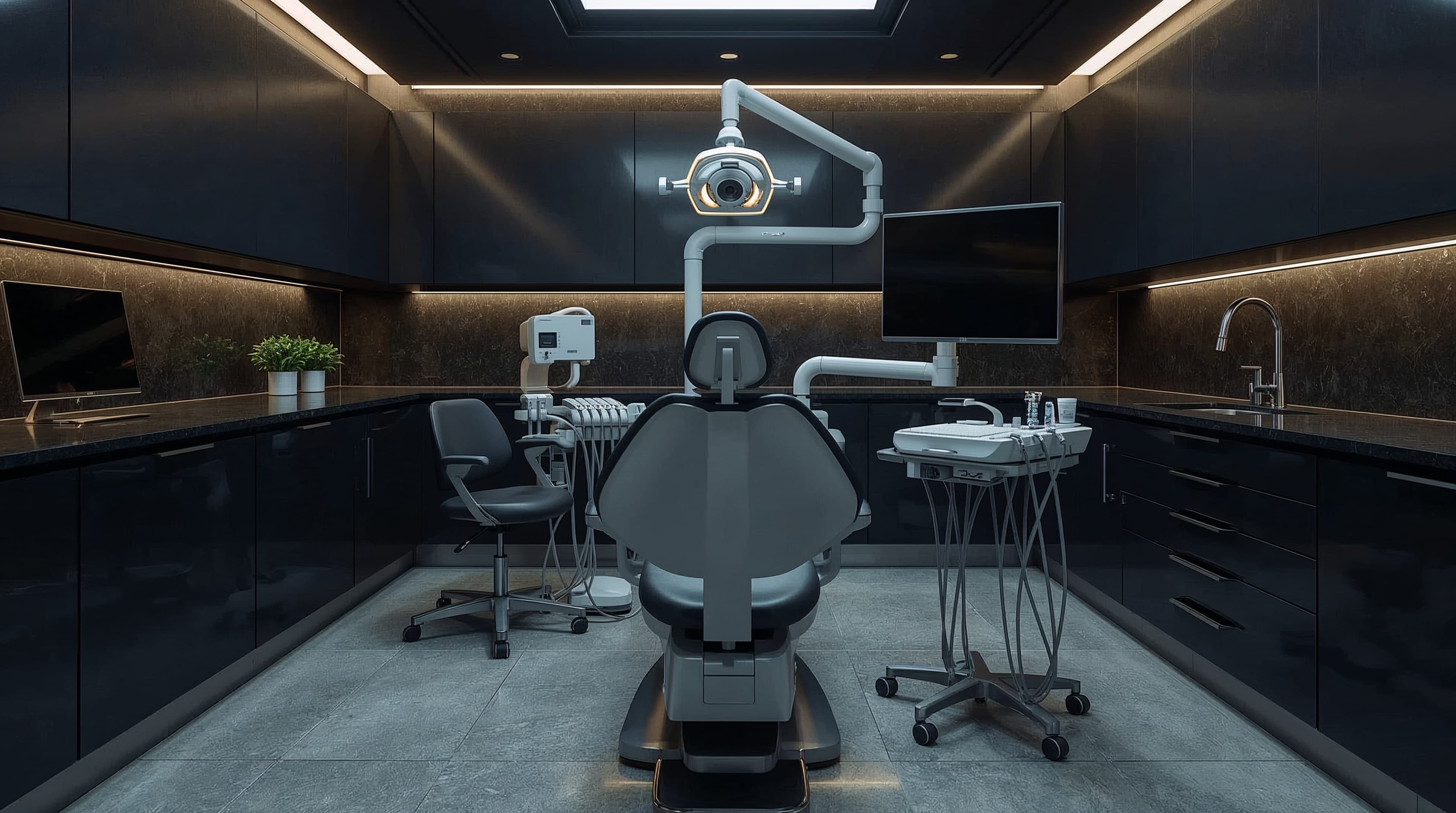
Most of the largest dental support organizations were built outward from general dentistry, treating endodontics, oral surgery, and periodontics as add-on service lines. Specialty1 Partners ran the play in reverse. A Houston platform founded by four practicing specialists, it set out to consolidate only the surgical corners of dentistry — root canals, extractions and implants, gum and bone surgery — and to do it while keeping dentists, not a financial sponsor, visibly in the driver's seat. For an investor mapping where specialty consolidation goes next, that focused, doctor-led structure is the entire thesis.
Market Intelligence
Dental Market Intelligence for Investors & Operators
The Molar Report tracks dental organizations, market expansion, competitive dynamics, and industry trends. Get our independent research as we publish it.
Overview
Specialty1 Partners (often styled S1P) is a dental support organization headquartered in Houston, Texas, focused exclusively on the three dental surgical specialties: endodontics, oral and maxillofacial surgery, and periodontics.1 It describes itself as doctor-founded and doctor-led, and is consistently identified in industry rankings as the largest platform dedicated specifically to these surgical specialties.2
The business is a specialty-focused DSO: Specialty1 does not practice dentistry. Instead it provides non-clinical business and operational support — billing and revenue-cycle management, human resources, marketing, purchasing, IT, compliance, and back-office infrastructure — to specialist-owned practices, so the doctors can, in the company's framing, maintain clinical autonomy and spend more time on patient care rather than running the business.1 The specialists keep clinical control (a structure that keeps the model compliant with state corporate-practice-of-dentistry laws), and Specialty1 earns its return through management and support arrangements plus the scale economies a few hundred offices can unlock.
What distinguishes Specialty1 from broader DSOs is its deliberately narrow clinical aperture and its multi-brand architecture underneath the parent. The platform operates through three specialty arms — Endo1 Partners (endodontics), OS1 Partners (oral surgery), and Perio1 Partners (periodontics) — and was, by its own account, the first group to offer a full suite of support services across all three surgical specialties.3
Company Snapshot
- Founded: As Endo1 Partners in October 2019, starting from six locations; reorganized under the Specialty1 Partners parent in December 2021.3
- Founders: Four dental specialists — Dr. Matthew Haddad and Dr. Daryl Dudum (Co-CEOs), and Dr. Mark Haddad and Dr. Darron Rishwain (Co-Chief Clinical Officers).1
- Headquarters: Houston, Texas.1
- Model: Specialty-focused dental support organization — non-clinical business support to specialist-owned surgical practices, organized under three brands (Endo1, OS1, Perio1).
- Specialties: Endodontics, oral and maxillofacial surgery, and periodontics.1
- Practices: Approximately 220 (company-reported); third-party rankings cite "220+," up from 130-plus at the end of 2021 (see Footprint Analysis).1
- Specialists: "350+" per the company's site; roughly 200-plus as of late 2021.1
- States: 28 (company-reported), up from 21 in late 2021.1
- Current owners: A portfolio company of Centerbridge Partners and VSS Capital Partners, with the four founders retaining a doctor-led leadership and ownership role; exact equity split is undisclosed (see Growth History).4
- Revenue: Not company-disclosed; we do not publish an estimate (see Business Model).
Footprint Analysis
Specialty1's scale is best read as a band rather than a single number, because the network adds affiliations continuously and the unit being counted shifts between sources — practices, specialists, and states each tell a slightly different story.
The company's own site is the cleanest current anchor: it reports approximately 220-plus practices, 350-plus specialists, and a presence in 28 states.1 The distinction between practices and specialists matters for an investor: a single affiliated practice can house several specialists, so the ~220 figure counts practices while the larger number counts individual clinicians, and the two should not be added together or conflated.
Third-party rankings corroborate that footprint and place it in competitive context. An industry ranking anchored to Becker's Dental Review (November 2025) lists Specialty1 at roughly 220-plus practices and 350-plus specialists across 28 states, dedicated to endodontics, oral and maxillofacial surgery, and periodontics.2 The growth curve underneath those numbers is sharp: the company describes starting at six locations in October 2019, reaching more than 130 practices and 200-plus specialists across 21 states by the end of 2021, and roughly 220 practices across 28 states by 2025-2026.3 Independent recognition tracks the same trajectory — Specialty1 appeared on the Inc. 5000 for four consecutive years, ranking No. 15 nationally in 2023 and No. 631 in 2024, and was cited with 71% two-year growth in regional rankings.5
The defensible reading: Specialty1 supports on the order of 220 practices and roughly 350 specialists across about 28 states, a genuinely national surgical-specialty footprint built almost entirely in the last six years. That scale places it among the larger specialty-only platforms but well below the 1,000-plus-office, general-dentistry-led leaders. A useful caution for an investor is that "28 states" signals breadth of reach, not depth in any one market — a specialty network spread thinly across many states carries different referral and density dynamics than a regionally concentrated one.
Growth History
Specialty1 has grown the familiar DSO way — practice affiliations plus de novo additions — but with two distinguishing features an investor should study: a fast specialty-by-specialty expansion, and a doctor joint-venture model that keeps clinicians in the equity.
The documented timeline, per company and sponsor sources, runs:
- October 2019 — Endo1 Partners founded. The four specialist co-founders launched Endo1 Partners as an "Endodontic Partnership Organization" with operations in Texas and California, beginning from six locations.3
- December 2019 — VSS recapitalization. Veronis Suhler Stevenson (VSS), a healthcare-focused private investment firm, made a growth investment to recapitalize Endo1, partnering with the four founders to accelerate acquisitions in a large, fragmented endodontic market. Terms were not disclosed.6
- December 2021 — reorganization into Specialty1 Partners. Having found a similar service gap for oral surgeons and periodontists, the founders created Specialty1 Partners as the parent organization and launched two new arms, OS1 Partners and Perio1 Partners, alongside Endo1. By that point the combined network had passed 130 practices, 200-plus specialists, and 21 states.3
- 2022-2024 — national scaling. The platform continued affiliating practices across all three specialties, with trade-press coverage through 2022 still describing it as VSS-backed, and database records noting continued buyouts (for example, a late-2024 transaction with a Florida implant and oral surgery center).5
- July 2025 — larger capital structure under joint sponsorship. A private-credit announcement described Specialty1 as a "Centerbridge Partners and VSS Capital Partners portfolio company" and detailed a new $525 million senior secured credit facility that replaced an outgrown bank-led facility to fund continued growth.4
The most important nuance for an investor is the ownership picture. VSS has been the financial backer since the 2019 recapitalization, and the most current public source (mid-2025) describes Specialty1 as jointly sponsored by Centerbridge Partners and VSS Capital Partners — indicating Centerbridge entered as an additional, institutional sponsor as the platform scaled.4 At the same time, the company continues to present itself as doctor-founded and doctor-led, and is grouped with the small set of platform-level dentist-led DSOs in industry rankings.2 The precise equity split among Centerbridge, VSS, and the founding doctors is not disclosed and cannot be confirmed; the defensible characterization is a private-equity-backed platform under joint Centerbridge and VSS sponsorship that has retained meaningful doctor leadership and ownership.
The second distinguishing feature is the joint-venture growth model. Rather than buying practices outright and salarying the doctors, Specialty1 emphasizes partnership structures in which affiliating specialists — and even associates who later buy in — hold equity. The company has publicized associate-to-partner transitions, such as a doctor elevated into ownership at an oral surgery practice in Pennsylvania, and 2026 multi-specialty joint ventures that fold a second specialty (for example, oral surgery) into an existing endodontic partnership.7 That equity-sharing approach is central to how a doctor-led platform recruits specialists who might otherwise resist a conventional roll-up.
Underlying Data
Need the data behind this analysis?
The Molar Report maintains structured datasets on the U.S. dental market. Request access for diligence or modeling.
- Practice location datasets
- DSO footprint tracking
- Geographic concentration analysis
- Market demographics
- Competitive landscape mapping
- Growth history
Business Model
Specialty1 earns money the way most DSOs do: by charging the practices it supports for business and management services, with the arrangement structured to capture a share of the efficiency it creates. Specialty1 does not bill patients for clinical care — the specialist-owned practices do that — and the company derives its revenue from its support relationships with them.1
The logic is the standard DSO efficiency case, applied to a higher-acuity setting. Surgical specialties carry equipment-intensive, referral-driven economics: cone-beam imaging, surgical microscopes, sedation workflows, and a steady inflow of cases referred from general dentists. Centralized purchasing, shared revenue-cycle and back-office labor, standardized systems, and group marketing let a few hundred specialty offices run leaner than each could alone, and the support organization takes a fee that still leaves the clinician an attractive economic outcome.4
Specialty1 does not publicly disclose revenue, and we are not publishing a third-party estimate; the available financial color comes from financing disclosures (such as the $525 million senior secured facility) rather than a clean revenue figure, so any model should treat Specialty1's top line as undisclosed.4
Two features distinguish the model. The first is its single-minded specialty focus: by consolidating only endodontics, oral surgery, and periodontics, Specialty1 builds operating depth in the surgical workflows and referral relationships that general-dentistry DSOs treat as peripheral — a deliberate contrast with the multi-specialty consolidators that lead with general practice.3 The second is the doctor-led, equity-sharing structure: the four founders run the company, and affiliating specialists participate in ownership through the joint-venture framework, which the platform leans on as both a recruiting tool and a retention mechanism.7
Technology & Software Ecosystem
Public detail on Specialty1's core practice-management stack is thin, but its technology posture is visible in one notable respect: the platform is described as running a proprietary support technology, an "Acumen Intelligence Engine," used to standardize operational and analytics workflows across its affiliated practices.2
The more structural technology point for a specialty DSO is referral-network infrastructure. Endodontists, oral surgeons, and periodontists depend heavily on a steady referral pipeline from general dentists, so managing referral relationships and case flow is a first-class operational workflow — the part of the technology stack a specialty platform must build early and a general-dentistry DSO often builds last.2 Specialty1's centralized, multi-state model implies that analytics, revenue-cycle, and referral tooling decisions are made at the platform level and pushed across affiliated practices, rather than office by office.
The caveat is that Specialty1 does not disclose its full underlying practice-management or imaging stack, so this should be read as illustrative of intent — a specialty platform standardizing analytics and referral workflows at scale — rather than an exhaustive inventory.
Competitive Landscape
Specialty1 sits in the specialty tier of a heavily consolidated U.S. DSO market — well below the general-dentistry giants by raw office count, but among the leaders within surgical-specialty consolidation. Using a 2025-2026 ranking anchored to Becker's Dental Review, the rough hierarchy of large DSOs by supported practice/office count runs:2
- Heartland Dental — more than 1,900 offices; majority-owned by KKR. The clear scale leader, general dentistry plus specialty.
- Aspen Dental — more than 1,100 offices; backed by Leonard Green & Partners and Ares Management.
- PDS Health (formerly Pacific Dental Services) — around 1,000 offices; notably dentist-owned at the platform level.
- MB2 Dental — 800-plus practices, with a doctor-partnership equity narrative; recapitalized by Warburg Pincus with Charlesbank retaining a stake.
- Dental Care Alliance — approximately 400 multi-specialty allied practices; Harvest Partners and Mubadala.
- Specialized Dental Partners — roughly 275-plus practices and 450-plus specialists across about 36 states; a separate, private-equity-backed endodontics/periodontics/oral-surgery platform based in Franklin, Tennessee.
- U.S. Oral Surgery Management — roughly 240-plus oral-surgery practices across about 31 states; based in Irving, Texas.
- Specialty1 Partners — approximately 220 practices and 350-plus specialists across 28 states; Houston-based, doctor-led, endodontics, oral surgery, and periodontics.
That places Specialty1 among the larger specialty-only platforms, though by raw practice count it trails the broad multi-specialty and general-dentistry leaders.2 Its closest comparables are the other surgical-specialty consolidators — and here a careful distinction matters. Specialty1 Partners (Houston) is a separate company from Specialized Dental Partners (Franklin, Tennessee) and from U.S. Oral Surgery Management (Irving, Texas); the similar names and overlapping specialty focus make the three easy to confuse, but they have different headquarters, owners, and histories and should not be conflated. Against this field, Specialty1's distinguishing features are its three-specialty breadth across the full surgical spectrum and its platform-level doctor-led, equity-sharing identity — most peers are either single-specialty (oral surgery only) or led by a financial sponsor rather than the founding clinicians.
Market Position
Specialty1 reads as a fast-built, focused platform optimized for surgical-specialty consolidation and clinician alignment rather than sheer office count or a consumer brand. Its strengths are real: a clear leadership claim within the three surgical specialties, a national 28-state reach assembled in roughly six years, a doctor-led structure that aligns incentives with the specialists it recruits, and a joint-venture model that gives affiliating doctors a continuing equity stake. The mid-2025 move to a $525 million senior secured credit facility signals both ambition and the confidence of institutional capital in the platform's growth runway.
The pressures are equally worth weighing. Specialty consolidation is increasingly crowded — Specialized Dental Partners and U.S. Oral Surgery Management pursue overlapping or adjacent territory, and the broad multi-specialty DSOs are extending into surgical service lines from much larger bases. A network spread across 28 states must convert breadth into genuine market density and reliable referral flow to defend its economics, and the new, larger debt facility raises the standard for cash-flow performance even as it funds growth. For an investor, Specialty1 is a focused, doctor-aligned, growth-stage platform whose next move — continued acquisition under joint Centerbridge and VSS sponsorship versus an eventual exit — is the key thing to watch, alongside how durably the doctor-led identity survives as institutional ownership scales.8
TMR Take: For operators (specialists weighing affiliation): Specialty1's pitch is built for surgical specialists specifically — its Endo1, OS1, and Perio1 arms mean an endodontist isn't supported the same way as an oral surgeon, and its joint-venture model offers continuing equity rather than a one-time buyout. Diligence the support-fee structure, ask how referral-network and analytics tooling actually work day to day, and understand how the associate-to-partner equity path is valued. For vendors: Specialty1 buys at the platform level — a centralized, multi-state operation standardizing analytics, revenue-cycle, and referral systems across 220-plus practices. That is an efficient sell-in if you can clear one corporate evaluation, and surgical specialties skew toward imaging, sedation, and referral-management technology rather than general-practice tooling. For investors: Specialty1 is the largest platform dedicated specifically to dentistry's three surgical specialties (~220 practices, ~350 specialists, ~28 states), doctor-founded and doctor-led, and a portfolio company of Centerbridge Partners and VSS Capital Partners as of mid-2025. The watch items are the joint ownership structure (VSS since 2019, Centerbridge as the later institutional sponsor; exact split undisclosed), the larger 2025 debt facility, an undisclosed top line with no company-confirmed revenue to model from, and an increasingly competitive specialty-consolidation field. Note the disambiguation carefully: Specialty1 Partners (Houston) is distinct from Specialized Dental Partners (Franklin, TN) and U.S. Oral Surgery Management (Irving, TX).
Sources
-
Specialty1 Partners — company website (footprint metrics, founders and executives, specialty focus, and support-model description).
-
Industry DSO rankings and sector reporting — Becker's Dental Review and Medix Dental's 2026 largest-DSO ranking (practice/specialist counts, states, competitive tier, and technology references).
-
Corporate history and reorganization — Endo1 Partners / Specialty1 Partners announcement introducing the parent company and the Endo1, OS1, and Perio1 brands, via Endodontic Practice US.
-
Ownership and capital structure — Encina Private Credit announcement of the $525 million senior secured credit facility, identifying Specialty1 as a Centerbridge Partners and VSS Capital Partners portfolio company.
-
Growth recognition and transactions — Inc. 5000 and Inc. Regionals rankings; Benesch Dental/DSO industry reporting; Levin Associates and Physician Growth Partners transaction coverage; PitchBook company profile.
-
Initial private-equity backing — Veronis Suhler Stevenson (VSS) announcement of its 2019 growth recapitalization of Endo1 Partners.
-
Joint-venture model — Specialty1 Partners communications on its doctor joint-venture framework and associate-to-partner ownership transitions.
-
The Molar Report analysis.


