Most dental support organizations chase breadth — every service line, every patient, every ZIP code. Affordable Care has spent five decades doing the opposite: it supports a national network of practices that do essentially one thing, tooth replacement, under a flagship brand most patients know simply as Affordable Dentures & Implants. For an investor sizing up the U.S. dental roll-up landscape, that single-minded focus is the whole story. It makes Affordable Care a very different animal from broad, full-spectrum consolidators like Heartland Dental or Aspen Dental — and gives it a defensible niche that few peers contest head-on.
This profile is an independent assessment based on company disclosures, private-equity sponsor materials, deal databases, and third-party industry data. Where the numbers come straight from Affordable Care, we say so; where they come from outside estimators, we flag the hedge — and on the question investors care most about, current ownership, we walk through exactly what the public record supports.
Market Intelligence
Dental Market Intelligence for Investors & Operators
The Molar Report tracks dental organizations, market expansion, competitive dynamics, and industry trends. Get our independent research as we publish it.
Overview
Affordable Care, LLC is a dental support organization (DSO) headquartered in North Carolina's Research Triangle Park, in the Raleigh-Durham / Morrisville area. The company describes itself as "America's leading consumer retail healthcare company exclusively focused on tooth replacement solutions," and traces its roots to 1975 — making it one of the older operators in the dental-services industry.1
Like its peers, Affordable Care does not practice dentistry. It provides non-clinical business support — real estate, call-center and scheduling, marketing, IT, finance, HR, group purchasing (through an affiliate, Sevaredent Sourcing Solutions), and compliance — to affiliated, dentist-owned practices. The dentists retain clinical autonomy and ownership of the professional entities (the structure that keeps the model compliant with state corporate-practice-of-dentistry laws); Affordable Care captures value through management and service fees tied to practice performance, plus the scale economics of purchasing and shared infrastructure.1
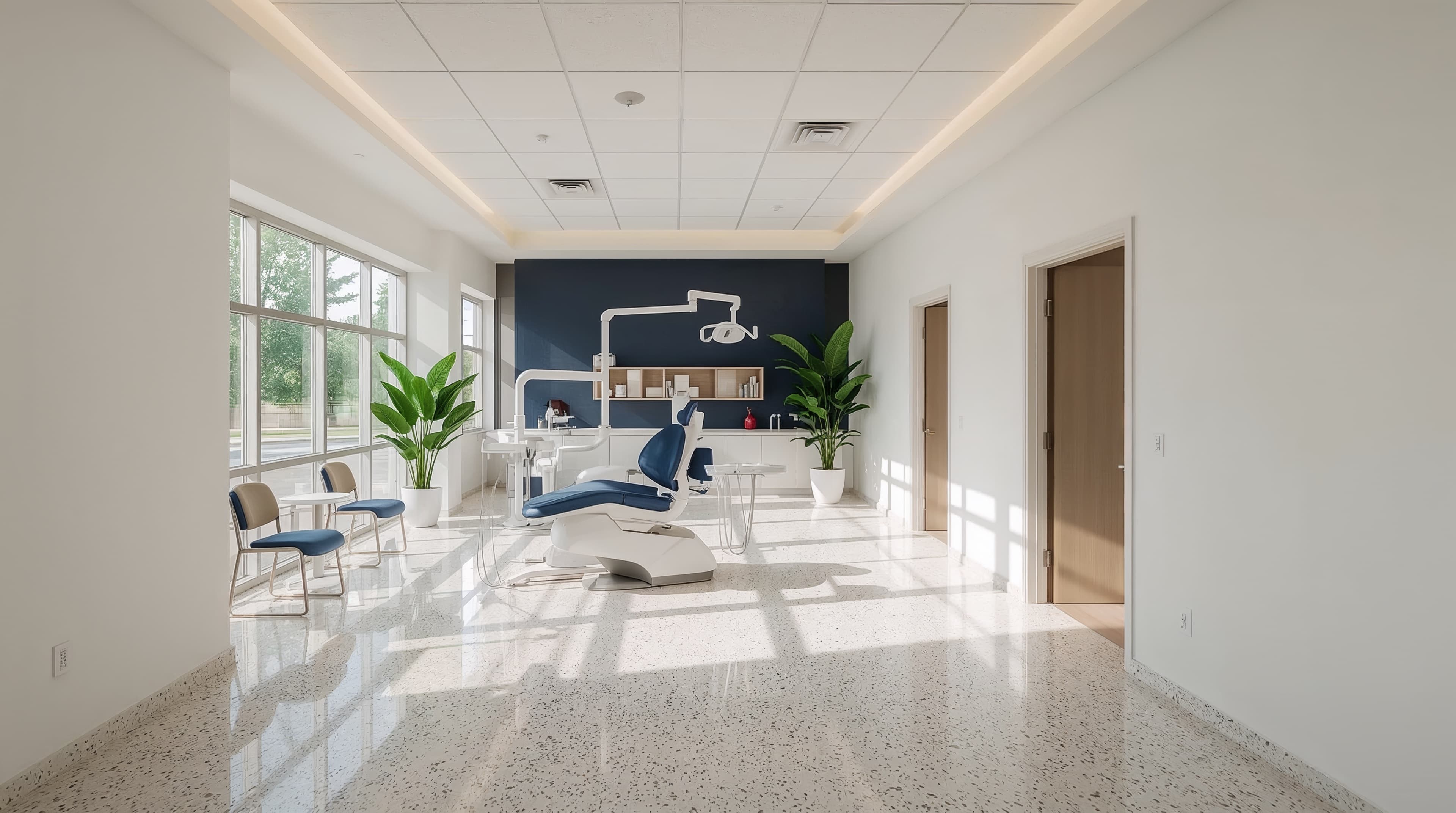
What sets it apart from almost every other large DSO is the narrowness of the clinical mission. Affordable Care's practices operate primarily under the Affordable Dentures & Implants (ADI) banner and focus on dentures, implants, and related prosthetic tooth replacement — not the full general-dentistry menu. The company also supports two sister brands, DDS Dentures + Implant Solutions and Advanced Dental Implant Center, and reports more than eight million patients treated across the network.2 A defining operational feature: many practices run on-site dental laboratories, letting a patient receive same-day dentures rather than waiting weeks for an outside lab — a genuine differentiator in this niche.3
Company Snapshot
- Founded: 1975 (company-reported).1
- Headquarters: Research Triangle Park, North Carolina (Raleigh-Durham / Morrisville area).1
- Model: Dental support organization — non-clinical business support to affiliated dentist-owned, tooth-replacement-focused practices.
- Clinical focus: Dentures and dental implants / tooth replacement — a deliberate single-specialty niche, distinct from full-spectrum DSOs.
- Flagship brand: Affordable Dentures & Implants; sister brands DDS Dentures + Implant Solutions and Advanced Dental Implant Center.2
- Affiliated practices: Roughly 340 to 400-plus, depending on source and date (see Footprint Analysis); company copy says "360+ practices in 39 states."1
- Patients served: "8 million+" (company-reported).1
- CEO: Pete Bridgman, who joined in 2024 from consumer-retail healthcare (ex-CEO of Visionworks; prior leadership at VSP Vision, Pearle Vision, and LensCrafters).1
- Current owner: Harvest Partners and PSP Investments (majority, since 2021), with Berkshire Partners as a minority co-investor (see Growth History).4
- 2021 deal valuation: approximately $2.7 billion enterprise value (third-party deal database; not company-confirmed).4
Footprint Analysis
Affordable Care's scale is hard to pin to a single number, and an investor should treat any point estimate as a snapshot of a moving target. The figures vary by source, by date, and — importantly — by whether a count refers to "practices," "offices," or "locations," units that are not always interchangeable.
The company's own About page reads: "360+ practices in 39 states."1 Other recent company and directory copy has phrased it as "360+ locations in 38 states" — a difference that reflects rounding and timing more than any real discrepancy.
Private-equity sponsor materials offer a slightly different cut: Berkshire Partners' portfolio page has described an affiliated footprint of approximately 340 locations across nearly 40 U.S. states, with the headquarters in the Raleigh-Durham / Morrisville area.4
Broader third-party estimates run higher. Industry analyses tracking the network's expansion describe growth from just over 320 supported practices to more than 400 — by some counts 425 — affiliated locations in roughly 40 to 42 states.3 The spread between the company's "360+" and the higher external counts most plausibly reflects whether sister brands are folded into the total, and how recently the count was taken.
The cleanest reading: Affordable Care supports on the order of 350 to 400-plus affiliated practices across roughly 40 states, with the company's headline "360+" in the middle of a moving range. What every source agrees on is the point that matters most: this is, by a wide margin, the largest U.S. DSO focused solely on dentures, implants, and tooth replacement, with no niche competitor close on location count.3
Growth History
Affordable Care has grown the way most DSOs do — a mix of de novo practice openings and acquisitions — and, like its peers, it has passed through a succession of private-equity owners. That ownership chain is the part of the story an investor should study most carefully, because the public record is partly muddy and several names that circulate in casual "who owns what" lists do not hold up.
Here is the most defensible reading of the documented chain, with hedges where the record is thin:
- American Capital (and possibly Northlane Capital Partners) — deal databases list these as early backers of the company before the mid-2010s. The exact chronology and terms of this pre-Berkshire era cannot be confirmed and should be treated as partial.4
- Berkshire Partners — became majority owner in the mid-2010s (exact date and valuation not disclosed), with Partners Group reported as a likely co-investor. Under Berkshire, the platform made its most strategically important acquisition: in 2019, it added DDS Dentures + Implant Solutions, combining the two largest denture-and-implant-focused groups in the country (terms not disclosed).4
- Harvest Partners and PSP Investments — in June 2021, this consortium (private-equity firm Harvest Partners alongside the Canadian pension fund Public Sector Pension Investment Board) acquired control of Affordable Care. A deal database reported the transaction at an enterprise value of approximately $2.7 billion — the only public dollar figure attached to the company, and one no underlying revenue or earnings multiple is disclosed against, so it should be read as directional.4
A more recent development belongs on any investor watch-list. Beginning in early 2026, press reports (Bloomberg and private-credit market coverage, later picked up by The Wall Street Journal) described Affordable Care working to restructure the roughly $1.4 billion private-credit term loan raised to help finance the 2021 buyout — a floating-rate loan reportedly arranged by KKR and held in largest part by Blackstone, with Antares Capital and New Mountain Capital also participating. According to those reports, the company engaged restructuring advisers as earnings softened and lenders marked the loan down, and by mid-2026 the lender group was reported to be moving toward a deal that would cut a large share of the debt and convert creditors into the company's controlling owners. The reporting concerns the capital structure, not the clinics: the affiliated practices reportedly continue to operate normally throughout, and no bankruptcy filing has been reported. For an investor, this is the single most important hedge on the platform — treat the 2021-era leverage as the open question and the restructuring as a reported, still-evolving process rather than a settled outcome.5
A note on current ownership, because casual lists get it wrong. The most defensible reading of the available evidence is that Harvest Partners and PSP Investments are the controlling owners as of 2025-2026, with Berkshire Partners retaining a minority stake that it rolled over in the 2021 sale. Both Harvest's and Berkshire's portfolio pages still list the company (Harvest under the holding-company name "ACI Parent, Inc."), and no subsequent change of control is documented.4 Two names that sometimes get attached to Affordable Care do not survive scrutiny: Sun Capital Partners, whose dental investment was actually ClearChoice — a separate implant platform it agreed to sell in 2020 — not Affordable Care; and GTCR, whose portfolio does not list the company. Both attributions appear to be confusions and should be set aside. As with any private company, the precise cap table and the equity split among Harvest, PSP, and Berkshire cannot be confirmed with certainty.4
The new chapter to watch is leadership rather than ownership: Affordable Care installed a substantially new executive team in 2024-2025, led by CEO Pete Bridgman, a consumer-retail healthcare veteran from the optical industry (Visionworks, VSP Vision, LensCrafters), alongside new clinical, operating, marketing, people, and IT chiefs.1 For an investor, that wholesale refresh usually signals a sponsor positioning the platform for its next phase — operational tightening, expansion, or an eventual exit.
Underlying Data
Need the data behind this analysis?
The Molar Report maintains structured datasets on the U.S. dental market. Request access for diligence or modeling.
- Practice location datasets
- DSO footprint tracking
- Geographic concentration analysis
- Market demographics
- Competitive landscape mapping
- Growth history
Business Model
Affordable Care earns money the way most DSOs do: by charging affiliated practices for the business support it provides, with fees structured to capture a share of the efficiency it creates. The company does not bill patients for clinical care — the dentist-owned professional entities do that — so its corporate revenue is the management-and-service-fee layer on top of practice billings, not the billings themselves. Third-party estimators have pegged annual revenue in the range of a few hundred million dollars; that figure is an outside estimate, not a company disclosure, and should be read as directional only.3
Two features distinguish the model from a generalist DSO. The first is the single-specialty focus. By concentrating on dentures and implants, the practices and support organization can standardize clinical workflows, marketing, and purchasing around a narrow set of procedures — and Affordable Care leans in with proprietary clinical programs (branded offerings like its UltimateFit denture, an implant package, and fixed-restoration systems) and a centralized group-purchasing function via its Sevaredent affiliate.1 Standardization is far easier when every practice solves the same clinical problem.
The second is the on-site dental laboratory. Most dental practices send denture and prosthetic work to outside labs, adding cost, margin leakage, and weeks of patient wait time. Affordable Dentures & Implants practices commonly run a lab on the premises, enabling same-day dentures.3 For the business, that captures lab margin in-house, controls turnaround, and offers a speed advantage hard for a generalist to match without the same infrastructure. The value-and-speed positioning is the commercial core: volume tooth replacement at an accessible price point, reinforced by the "affordable" in the brand name itself.
Technology & Software Ecosystem
Public detail on Affordable Care's technology stack is thin — thinner than for several peers. The company's consumer-facing and corporate materials emphasize affordability, on-site labs, and same-day service, but do not name specific practice-management systems, digital-workflow platforms, or AI vendors, and there is little independent disclosure of the stack.3
What can be said is structural rather than specific. Affordable Care lists IT consulting among its centralized support functions, implying a managed, support-org-level technology layer rather than each practice choosing its own tools.1 The on-site-lab model also implies investment in digital dentistry — intraoral scanning and same-day prosthetic fabrication are increasingly how a same-day denture gets made — though the company does not detail the platforms involved. Notably, it appointed a new Chief Information Officer in 2025 (from technology roles at Oracle, Walmart, and Dell), a hire that signals intent to modernize the stack even if specifics are not yet public.1
The caveat for any investor or vendor: treat the technology picture as a data gap, not a finding. The absence of public detail is itself the takeaway — the diligence work here is unfinished from the outside.
Competitive Landscape
Affordable Care occupies an unusual position: it is simultaneously a large national DSO and a near-monopolist in a narrow niche. Both framings matter.
By overall office count, Affordable Care sits in the upper-middle tier of a consolidated U.S. DSO market. Recent rankings drawing on Becker's Dental Review place it roughly in the top 8 to 12 DSOs nationally by location count — its ~350-400-plus practices a clear step below the largest full-spectrum platforms:6
- Heartland Dental — well over 1,800 offices; the clear scale leader; KKR-backed.
- Aspen Dental (The Aspen Group) — more than 1,100 offices; backed by Leonard Green & Partners and Ares.
- PDS Health (formerly Pacific Dental Services) — roughly 1,000 offices; dentist-owned at the platform level.
- Smile Brands — roughly 650-700 offices under 75-plus consumer brands; Gryphon Investors.
- MB2 Dental — roughly 750-800 offices; a doctor-partnership model.
- Affordable Care — roughly 350-400-plus tooth-replacement practices; Harvest Partners / PSP / Berkshire.
But by clinical niche, the comparison set narrows dramatically — and Affordable Care leads it. Its only direct national peer in implant-and-denture-focused care is ClearChoice Dental Implant Centers, owned by The Aspen Group (the same parent as Aspen Dental). The two are positioned very differently: ClearChoice runs roughly 90-100 centers concentrated on premium, full-arch fixed-implant restorations (All-on-X-type cases) with heavy advertising and higher fees, while Affordable Dentures & Implants runs four-times-plus the locations at a value price point, anchored on same-day dentures.3 In effect, ClearChoice owns the premium full-arch end of tooth replacement and Affordable Care owns the value, high-volume end — they overlap but do not collide head-on.
That dual position is the strategic crux: Affordable Care is mid-sized among generalist DSOs but the dominant player in a defensible vertical that the giants address only at the margins.
Market Position
Affordable Care is best understood as a mature, single-specialty platform optimized for volume and affordability in tooth replacement — not a generalist racing for office count. Its strengths are real and durable: a five-decade history, the largest network in a niche it effectively defined, an operational moat in the on-site-lab / same-day-denture model, a recognizable brand, and a clinical focus that makes standardization and group purchasing more powerful than for a sprawling generalist.
The pressures are equally real. The single-specialty focus that protects it also concentrates its exposure — tooth replacement is sensitive to discretionary spending, patient financing, and demographic and reimbursement shifts in a way a diversified DSO can partly absorb. Public technology disclosure is thin, leaving an open question about how modern the operating stack is (the 2025 CIO hire suggests management knows it). And the ownership structure — a 2021 buyout at a reported ~$2.7 billion that brought in Harvest Partners and PSP Investments alongside a rolled-over Berkshire minority, followed by a near-total executive refresh — is the classic setup for a platform being readied for its next act. For an investor, Affordable Care reads as a stable, niche-leading, cash-generative platform whose next chapter hinges on how well a new leadership team executes a focused, defensible model.
TMR Take: For operators (dentists weighing affiliation): Affordable Care offers something rare — a chance to build a practice around one thing you can get very good at, with the marketing, real estate, purchasing, and on-site-lab infrastructure handled for you. If denture-and-implant volume is your calling, the focused support model and same-day-lab tooling are genuine advantages. Diligence the fee structure and how production targets interact with the platform's ownership economics. For vendors: This is a focused, centralized buyer. IT is a support-org function, so procurement decisions are made at the platform level, not office by office — and the new 2025 CIO signals an active modernization window. The single specialty means a vendor that nails denture/implant digital workflows, on-site-lab integration, or revenue cycle for this exact use case has an unusually clean pitch. For investors: Affordable Care is a mid-sized U.S. DSO (~350-400-plus practices, ~40 states) but the dominant national player in dentures-and-implants tooth replacement, a defensible niche the generalists touch only at the edges. The watch items: concentration risk in a single discretionary-spend specialty, a thin public technology picture, and an ownership story casual sources get wrong. Harvest Partners and PSP are the controlling owners (since 2021, ~$2.7B reported EV) with Berkshire a rolled-over minority; the circulating Sun Capital and GTCR "ownership" claims do not hold up. Treat the ~$2.7B figure as a third-party deal-database number and the revenue estimates as unverified. The live watch-item is the capital structure: press reports describe a restructuring of the ~$1.4B private-credit loan from the 2021 buyout, with lenders led by Blackstone and KKR reportedly moving to take control — a balance-sheet event to diligence closely, even as the affiliated clinics reportedly keep operating.5
Sources
-
Affordable Care — company website, About page, and corporate disclosures.
-
Affordable Dentures & Implants — brand materials and practice network.
-
Third-party market analysis — DSO directories, deal databases, and practice-level reporting.
-
Ownership / private-equity sources — Harvest Partners and Berkshire Partners portfolio pages, Preqin deal database, and deal coverage (PE Hub, Benesch DSO market intelligence).
-
Debt restructuring — The Wall Street Journal, Bloomberg, and private-credit market coverage.
-
Industry DSO rankings — Becker's Dental Review.